
Exquintia
Diensten

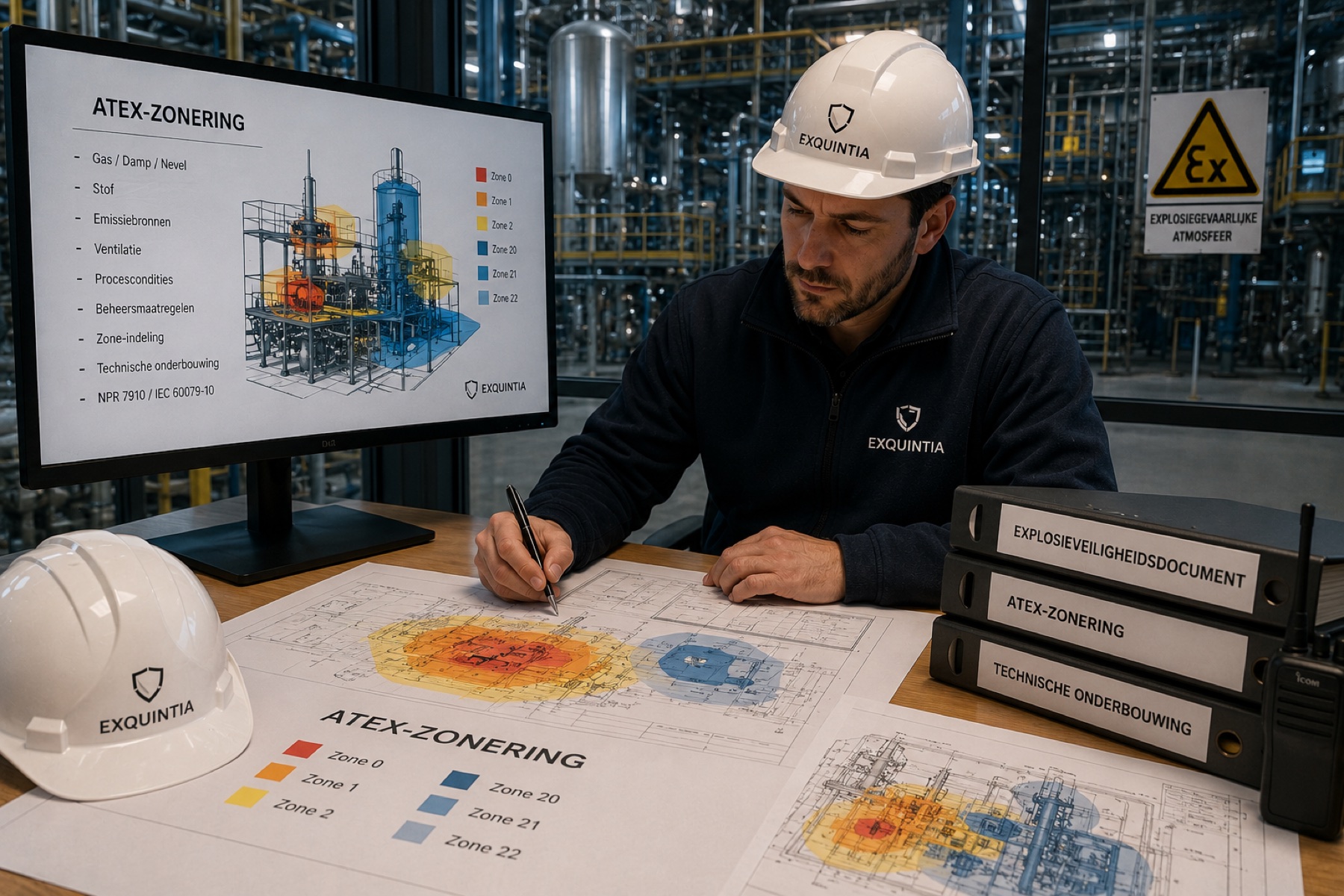
ATEX zoning | Gas, vapour, mist and dust

ATEX zoning: create, update or review

ATEX zoning is the technical basis for almost every explosion safety assessment.

Exquintia helps companies create, update and review ATEX zoning for gas, vapour, mist and dust explosion hazards.

What you buy

A concrete ATEX assessment with usable next steps.

Exquintia does not deliver a generic safety note, but a technical assessment aligned with your installation, process and documentation. You receive clarity on risk, standards basis, missing information and priorities for execution.

  • Scope aligned with EPD, zoning, inspections, audit preparation or risk analysis.
  • Review of documentation, installation, equipment and organisational controls as one system.
  • Clear findings with priority, practical actions and substantiation for HSE, engineering and management.
01

Technical substantiation

A reliable zoning assessment shows where explosive atmospheres can occur, how often and for how long they may be present, and which equipment and measures are required.

Exquintia assesses zoning from the actual process, not only from a standard table.

02

What Exquintia delivers

The installation is assessed systematically, based on substances, emission sources, ventilation, dust behaviour, operating conditions and maintenance practice.

  • inventory of flammable gases, vapours, mists and dusts
  • assessment of emission sources and release grades
  • classification of zones 0, 1 and 2 for gas hazards
  • classification of zones 20, 21 and 22 for dust hazards
  • assessment of ventilation, dilution and extraction
  • review of dust layers, dust clouds and secondary explosion risks
  • zone dimensions and spatial boundaries
  • review of existing zoning drawings
  • link with equipment selection, EPL, temperature class and dust group
  • report with assumptions, rationale and practical conclusions
03

Result

After completion, you have a substantiated ATEX zoning assessment or an independent review of your existing zoning.

You know where hazardous areas are present, why zones were selected and what this means for equipment, work activities and measures.

Choose the right next step directly

Use the contact form for a focused ATEX request. It is immediately clear whether you need an intake, quickscan or EPD review.