
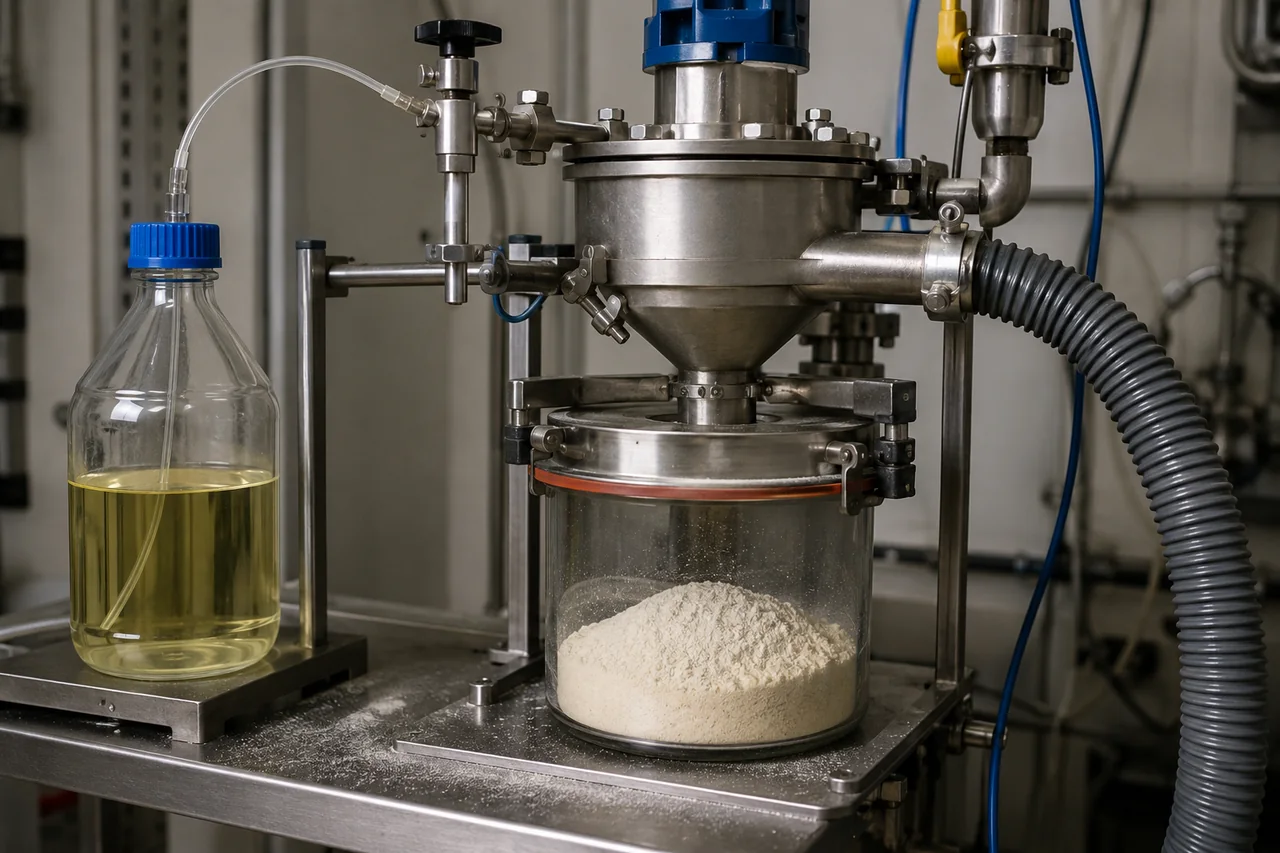
Wet dust is not always safer
In explosion safety, a familiar argument is often heard: “The dust is wet, so its ignition sensitivity will probably be lower.”
When the moisture is water, that reasoning can be technically defensible. Water absorbs heat, has to be heated, and must evaporate before the dust particle can effectively participate in combustion. As a result, the minimum ignition energy, or MIE, may increase. Even then, however, this assumption is only valid if the moisture content is actually present in the process, is homogeneously distributed, and is maintained under all operating conditions.
But what happens when the “moisture” is not water?
Take cellulose wetted with ethanol.
In that case, we are no longer dealing with simply wet dust. We are dealing with a combustible dust in combination with a volatile flammable liquid. Ethanol can evaporate and form an explosive vapour-air atmosphere. Cellulose, when finely divided and dispersed, can form an explosive dust cloud. Together they can create a hybrid explosive atmosphere: vapour and dust present in the same scenario.
That is exactly where the risk lies.
In a hybrid mixture, the ignition behaviour can differ significantly from that of the individual substances. Ethanol vapour may support ignition of the cellulose dust cloud. The MIE of the overall mixture may be lower than expected if the assessment only considers the dry dust or a water-wetted dust sample. The lower explosion limit, explosion pressure, rate of pressure rise and the effectiveness of ignition prevention measures may also differ from the values expected for the separate components.
The right question is therefore not:
“Is the dust wet?”
The right question is:
“Where can ethanol evaporate, where can cellulose be present as a dust cloud, and can vapour and dust occur at the same time?”
That distinction is essential for ATEX and DSEAR assessments. For cellulose, the focus is on dust explosion hazards, dust clouds, dust layers, dispersion and ignition sources. For ethanol, the focus is on vapour formation, ventilation, LEL, temperature, sources of release and possible gas or vapour hazardous areas. Where both can be present at the same time, these assessments must not be treated as two separate worlds.
Under the European ATEX workplace requirements, the employer must assess the possibility of explosive atmospheres, identify ignition risks and document suitable technical and organisational measures. In the United Kingdom, the same logic is reflected in DSEAR, where employers must assess risks from dangerous substances, prevent or adequately control explosive atmospheres and manage ignition sources. For equipment, the European ATEX equipment framework and the UK Equipment and Protective Systems Regulations require equipment and protective systems to be suitable for the intended explosive atmosphere and operating conditions.
From a technical perspective, the assessment cannot stop at a single dust data sheet. EN 1127-1 requires the explosion risk to be assessed by considering the presence of explosive atmospheres, the likelihood of ignition sources and the expected effects of an explosion. EN/IEC 60079-10-1 and EN/IEC 60079-10-2 provide the framework for classifying gas, vapour and dust hazardous areas. EN/IEC 60079-14 is relevant for the selection, design and installation of electrical equipment in explosive atmospheres, while EN/IEC 60079-32-1 is particularly important when electrostatic hazards may influence ignition. For combustible dust characteristics and test methods, EN ISO/IEC 80079-20-2 is relevant.
In practice, this scenario can arise during mixing, drying, impregnation, cleaning, filtration, extraction, sampling, storage or internal transport. A product may appear “wet” at the point of feed, while a flammable vapour-dust combination develops in a filter, duct, dryer, extraction point or enclosed process section. This is especially relevant where warm surfaces, reduced-pressure systems, poor ventilation or recirculation can cause the real process condition to differ significantly from the assumption on paper.
A robust explosion safety assessment must therefore consider the most unfavourable realistic process condition. Not the average moisture content of the product, but the scenario in which ethanol can evaporate sufficiently and cellulose can be present in a sufficiently fine and dispersed form.
That requires more than standard material data. It requires process knowledge, assessment of sources of release, ventilation, ignition sources, dust layers, vapour formation and the possible interaction between dust and vapour.
The key lesson is simple:
Water can make dust less ignition-sensitive.
Ethanol can turn “wet dust” into a hybrid explosion risk.
Anyone who only asks whether a dust is dry or wet is asking the wrong question. The real question is which medium is present, under which process conditions it can be released, and whether dust and vapour can form an explosive atmosphere together.
Explosion safety does not begin with assumptions.
Explosion safety begins with the right scenario.
https://exquintia.com/
Sources:
Abbasi, T. & Abbasi, S.A. – Dust explosions: Cases, causes, consequences, and control, Journal of Hazardous Materials, 2007.
Addai, E.K., Gabel, D., Krause, U. – Minimum ignition energy of hybrid mixtures.
Proust, C. – Dust explosions in the process industries.
EN 1127-1 – Explosive atmospheres – Explosion prevention and protection – Basic concepts and methodology.
EN/IEC 60079-10-1 – Explosive atmospheres – Classification of areas – Explosive gas atmospheres.
EN/IEC 60079-10-2 – Explosive atmospheres – Classification of areas – Explosive dust atmospheres.
EN/IEC 60079-14 – Explosive atmospheres – Electrical installations design, selection and erection.
EN/IEC 60079-32-1 – Explosive atmospheres – Electrostatic hazards, guidance.
EN ISO/IEC 80079-20-2 – Explosive atmospheres – Material characteristics – Combustible dusts test methods.
ATEX Directive 1999/92/EC – Minimum requirements for improving the safety and health protection of workers potentially at risk from explosive atmospheres.
ATEX Directive 2014/34/EU – Equipment and protective systems intended for use in potentially explosive atmospheres.
UK DSEAR – Dangerous Substances and Explosive Atmospheres Regulations.
UK Equipment and Protective Systems Intended for Use in Potentially Explosive Atmospheres Regulations.
#ATEX #DSEAR #ExplosionSafety #HybridMixtures #Cellulose #Ethanol #MIE #DustExplosion #VapourExplosion #ProcessSafety #HazardousAreas #IgnitionSourceAnalysis #IEC60079 #ISO80079 #EN1127 #Exquintia