
Heatwaves and explosive atmospheres: when ambient temperature reduces the safety margin
Most people associate a heatwave with heat stress for workers or a higher cooling demand from process installations. In explosion safety, however, prolonged heat has another effect that is often underestimated. Higher ambient temperatures can change process conditions and, with them, the assumptions on which the explosion risk assessment was originally based.
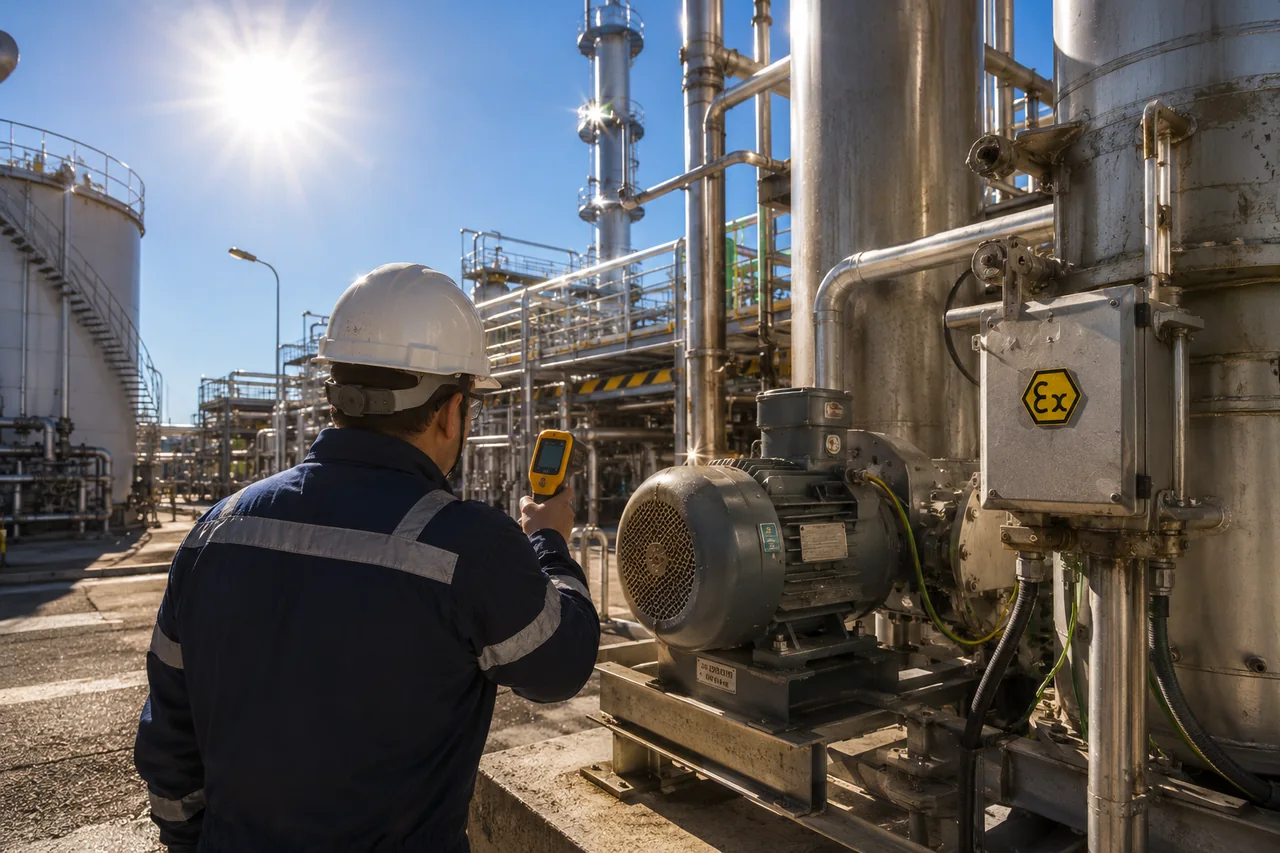
Many items of Ex equipment are selected for a defined ambient temperature range, usually stated as Ta or Tamb in the marking, certificate or manufacturer’s documentation. Typical values may be up to +40 °C, +55 °C or +60 °C, depending on the equipment design and certification. When equipment is exposed to direct sunlight, the actual surface temperature of an enclosure can be significantly higher than the measured air temperature. Dark Ex d, Ex e and Ex t enclosures, motors, junction boxes and field instruments may therefore operate with a smaller thermal margin than expected.
This is not only an equipment issue. Higher temperatures also affect the behaviour of flammable liquids. Vapour pressure increases as temperature rises, which can lead to greater release of flammable vapours. At storage tanks, pumps, sampling points, loading and unloading stations and process units, the actual emission rate may therefore become higher than the value assumed during the original hazardous area classification.
Ventilation can also change during a heatwave. In many plants, doors, shutters or roof openings are opened to cool the workplace. That may appear sensible from an operational point of view, but it can completely alter airflow patterns. A local extraction system that performs well under normal conditions may become less effective when crossflows, thermal buoyancy or open doors disturb the designed airflow. The explosive atmosphere may then disperse differently, persist longer or reach areas that were not considered critical in the original assessment.
In the food, feed and powder industries there is an additional effect. Organic materials such as flour, starch, sugar, milk powder, cocoa and spices may become drier when the air is warm and dry. This can increase the fine fraction of dust and make dust clouds easier to form during conveying, dosing, filling, cleaning or disturbance of deposits. A plant that looks clean during normal operation can still develop a relevant dust explosion scenario when process conditions and environmental conditions change at the same time.
For European sites, this means that the assessment should not stop at the formal ATEX zoning drawing. Directive 1999/92/EC requires employers to assess explosion risks at the workplace, define hazardous areas, prevent ignition and document the protective measures. Directive 2014/34/EU governs equipment and protective systems placed on the EU market. The technical basis is normally supported by standards such as EN 1127-1, EN IEC 60079-10-1, EN IEC 60079-10-2, EN IEC 60079-14 and EN IEC 60079-17. These standards are useful only when the actual operating conditions still match the assumptions used in the design, selection, installation and inspection of the equipment.
For the United Kingdom, the same technical question exists under a different legal framework. DSEAR requires employers and the self-employed to assess and control risks from dangerous substances, including explosive atmospheres. Equipment placed on the Great Britain market is addressed through the Equipment and Protective Systems Intended for Use in Potentially Explosive Atmospheres Regulations 2016. In practice, the operator still has to demonstrate that the hazardous area classification, equipment suitability, inspection regime, maintenance and operating controls remain valid under the real conditions of use.
A heatwave is therefore not only a meteorological event. It is a moment when process safety and explosion safety deserve renewed attention. A current risk assessment should not only look at the classified hazardous area, but also at changing process conditions, ventilation performance, emissions, dust behaviour and the real ambient and surface temperatures of Ex equipment.
The question every explosion safety professional should ask during hot summer days is therefore not simply:
“How hot will it be outside?”
The better question is:
“Does my installation still operate within the assumptions of the original explosion risk assessment under these conditions?”
Closing question for LinkedIn
Does your organisation carry out additional checks on Ex equipment, ventilation and process conditions during a heatwave, or is it assumed that the original explosion risk assessment remains valid under all summer conditions?
https://exquintia.com/
#ATEX #ExplosionSafety #ProcessSafety #DSEAR #IEC60079 #IECEx #FoodIndustry #ChemicalIndustry #SEVESO #RiskAssessment #IndustrialSafety #HazardousAreas #Exquintia