
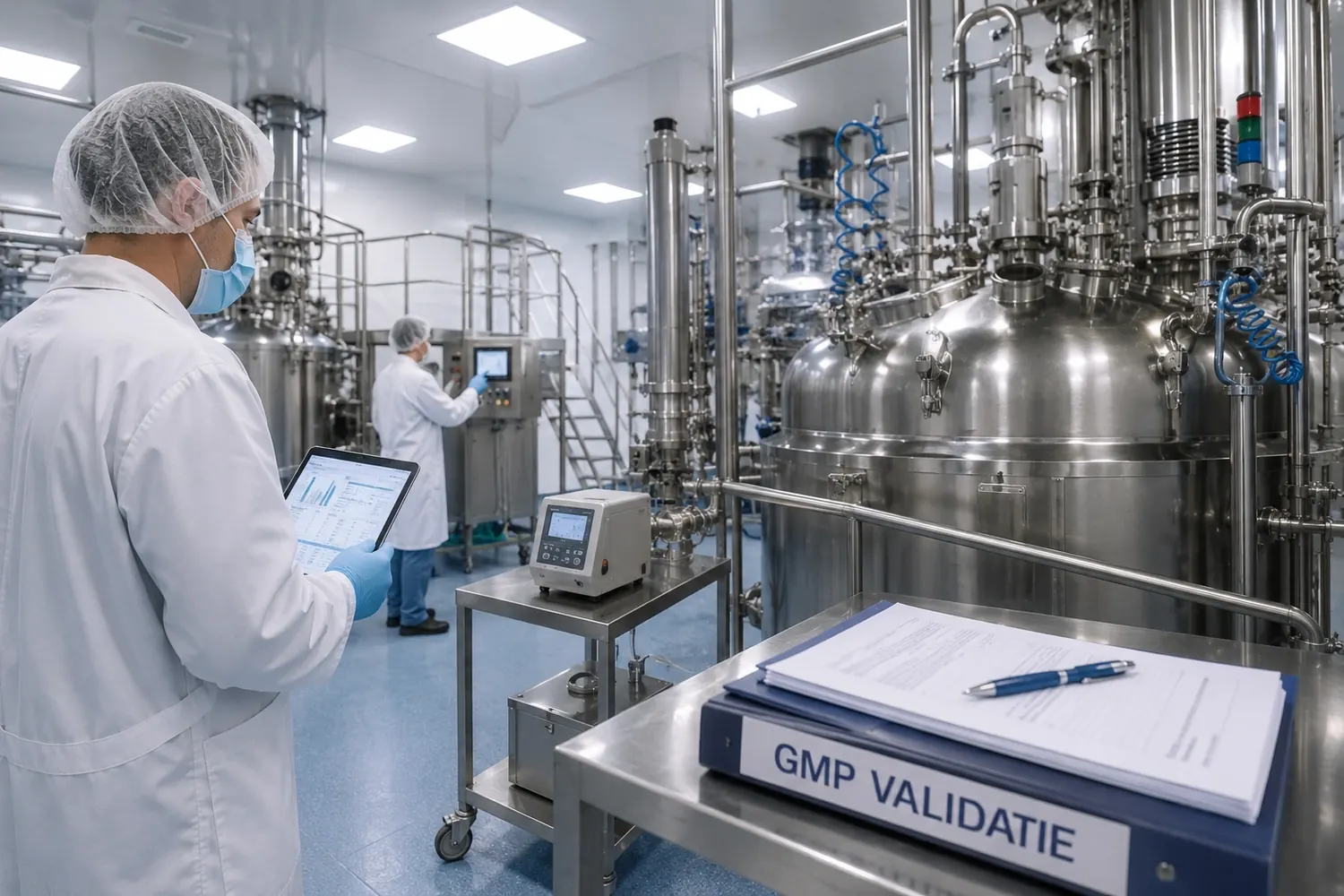
GMP Validation Confirms Product Quality – But Not Automatically the Explosion Safety of a Facility
The pharmaceutical industry is one of the most highly regulated sectors in the world. Every stage of production—from raw material to finished medicinal product—is validated, documented and controlled. Sterile manufacturing processes, cleanrooms, isolators, and automated Cleaning-in-Place (CIP) and Sterilisation-in-Place (SIP) systems ensure reproducible production conditions and provide the foundation for patient safety and product quality in accordance with the EU GMP Guidelines, particularly Annex 1.
This often leads to an unintended assumption: if a manufacturing facility is fully GMP compliant, its explosion safety must also be under control.
In practice, however, these are two distinct engineering disciplines, each with its own objectives.
Pharmaceutical manufacturing frequently involves the use of flammable solvents such as ethanol, isopropanol, methanol and acetone. In addition, micronisation, milling, granulation, fluid-bed drying and tablet production can generate fine combustible dusts capable of forming explosive atmospheres under certain operating conditions. Modern pharmaceutical facilities therefore combine the highest standards of product quality with complex explosion protection challenges.
The greatest challenge rarely arises during the initial validation of a new facility. It develops throughout the operational lifecycle. Product portfolios evolve, batch sizes become smaller, isolators are replaced, ventilation systems are optimised and energy-efficiency improvements are implemented. Each modification may affect the original assumptions underlying hazardous area classification, ventilation design and ignition hazard assessments, while the GMP validation itself remains fully valid.
For this reason, explosion protection has become an integral part of modern Pharmaceutical Quality Systems (PQS). Quality Risk Management in accordance with ICH Q9, Management of Change, Asset Integrity, the ATEX Workplace Directive (1999/92/EC) throughout the European Union, the Dangerous Substances and Explosive Atmospheres Regulations (DSEAR 2002) in the United Kingdom, together with the IEC 60079 series, provide the engineering framework for designing, operating, inspecting and modifying facilities where explosive atmospheres may occur.
A GMP validation demonstrates that a facility is capable of consistently manufacturing medicinal products that meet the required quality standards. It does not replace an explosion risk assessment, periodic reviews of hazardous area classification, ignition hazard assessments, verification of explosion-protected equipment, or the updating of the Explosion Protection Document (EU) or equivalent explosion risk documentation (UK) following technical modifications.
The pharmaceutical companies that will lead the industry in the future will not be recognised solely for the quality of their medicines. They will be recognised for systematically evaluating every technical modification from both a GMP and an explosion protection perspective, ensuring product quality, process safety, asset integrity and business continuity throughout the entire lifecycle of the facility.
References
Health and Safety at Work etc. Act 1974 (UK)
Dangerous Substances and Explosive Atmospheres Regulations 2002 (DSEAR)
ATEX Workplace Directive 1999/92/EC
ATEX Equipment Directive 2014/34/EU
EU Guidelines for Good Manufacturing Practice (EU GMP), Annex 1: Manufacture of Sterile Medicinal Products
ICH Q9(R1) – Quality Risk Management
IEC 60079-10-1 – Classification of hazardous areas (gas)
IEC 60079-10-2 – Classification of hazardous areas (dust)
IEC 60079-14 – Design, selection and installation
IEC 60079-17 – Inspection and maintenance
IEC 60079 Series – Explosive Atmospheres
Hashtags
#Pharmaceutical #Pharma #GMP #Annex1 #ICHQ9 #QualityRiskManagement #ExplosionSafety #ATEX #DSEAR #IEC60079 #AssetIntegrity #ProcessSafety #ManagementOfChange #Engineering #Maintenance #OperationalExcellence #BusinessContinuity #IndustrialSafety #Exquintia