
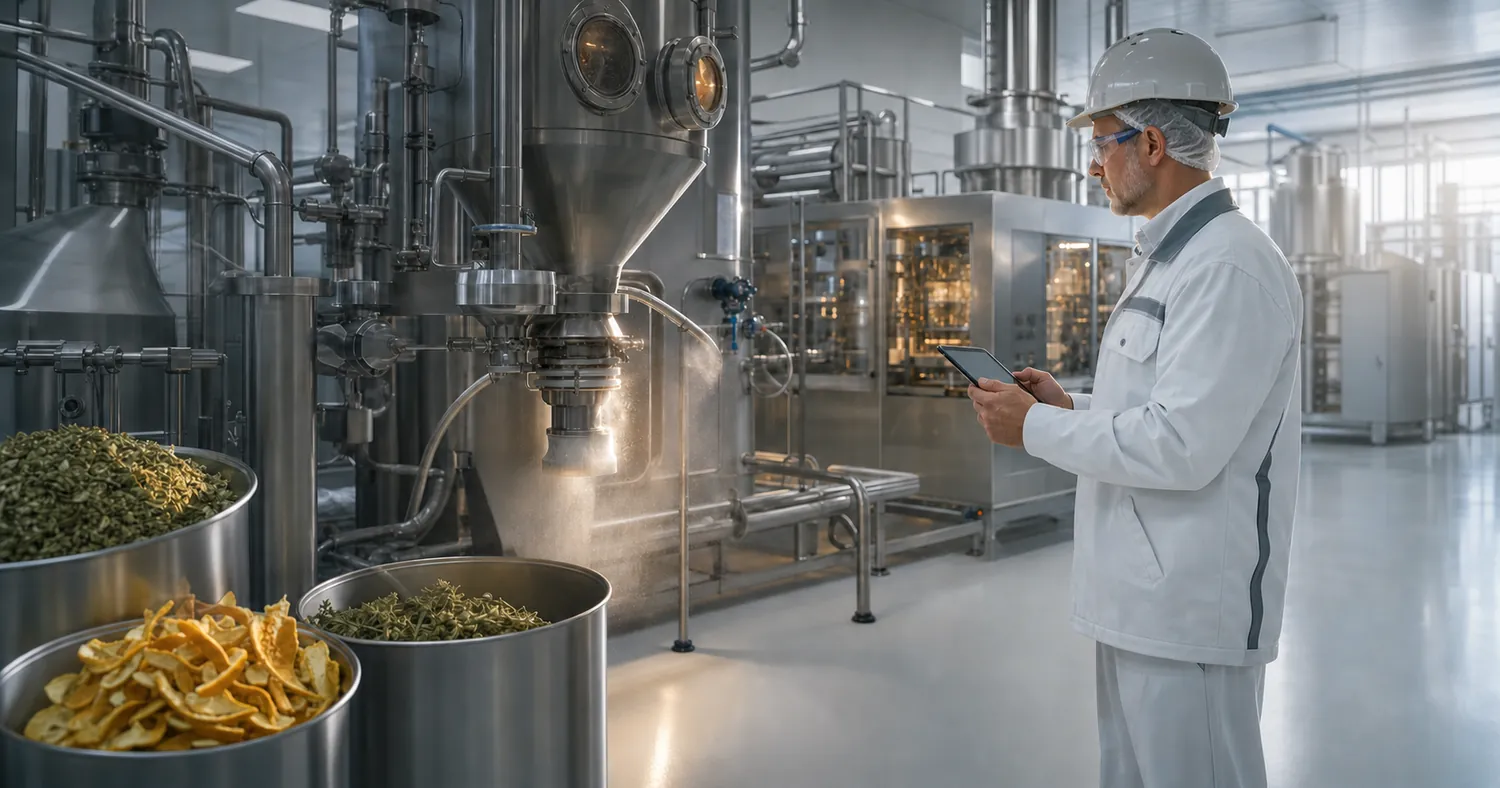
The transition to natural flavourings can also change explosion risks—often without being noticed
The food industry is undergoing a fundamental transition. Consumers increasingly expect natural flavourings, clean-label products and more sustainable manufacturing methods. Producers are therefore investing in new extraction technologies, smaller production batches, energy-efficient equipment and a wider variety of raw materials.
These developments can strengthen competitiveness. At the same time, however, they may alter the technical assumptions on which existing process installations and explosion-protection measures were originally based. This aspect still receives comparatively little attention.
Flavouring production frequently combines processes such as ethanol extraction, distillation, solvent recovery, spray drying, fluid-bed drying, milling, blending and powder handling.
Each process stage presents its own combination of flammable gases or vapours, combustible dust clouds and potential ignition sources. Individually, these hazards can usually be controlled. The challenge arises when processes are modified to make production more sustainable, energy-efficient or flexible.
An energy-saving measure may, for example, affect the performance of a ventilation or extraction system. A new natural raw material may have different dust characteristics, explosion parameters or volatile constituents. Changes to a spray dryer can influence dust concentrations and deposits. Solvent-recovery systems may be optimised to reduce emissions while simultaneously being expected to deliver greater plant availability.
However, the existing hazardous-area classification, selection of Ex equipment and assessment of ignition sources are often based on the original operating conditions. Following a process modification, those assumptions may no longer remain fully valid.
Within the European Union, workplace explosion risks are principally addressed through the ATEX Workplace Directive 1999/92/EC. Equipment and protective systems placed on the EU market fall within the scope of the ATEX Product Directive 2014/34/EU.
In Great Britain, workplace duties are primarily governed by the Dangerous Substances and Explosive Atmospheres Regulations 2002, commonly known as DSEAR. Equipment and protective systems supplied for potentially explosive atmospheres are covered by the Equipment and Protective Systems Intended for Use in Potentially Explosive Atmospheres Regulations 2016.
Northern Ireland has a separate product regime that remains aligned with relevant EU requirements under the Windsor Framework. Organisations operating across several jurisdictions should therefore verify which conformity-assessment and marking requirements apply in each market.
Technical implementation is supported by the applicable editions and national adoptions of the IEC 60079 series, including EN IEC 60079 within the EU and BS EN IEC 60079 within the UK. Relevant parts address hazardous-area classification for gases and combustible dusts, the selection and installation of Ex equipment, and the inspection and maintenance of electrical installations.
Explosion safety is therefore becoming an integral part of sustainable asset management in the flavouring industry. Management of Change, Asset Integrity, process safety and explosion-risk assessment must work together before a modification becomes part of routine production.
This is not simply about regulatory compliance. Safe and dependable production facilities are fundamental to a reliable food supply chain.
The most future-ready flavouring manufacturers do more than develop new tastes. They ensure that every process innovation also strengthens the safety, availability and reliability of their facilities.
Sources and further reading:
• Directive 1999/92/EC – protection of workers potentially at risk from explosive atmospheres
• Directive 2014/34/EU – equipment and protective systems for potentially explosive atmospheres
• HSE – Dangerous Substances and Explosive Atmospheres Regulations 2002
• UK Government – Equipment for explosive atmospheres regulations
• UK Government – designated standards for equipment used in explosive atmospheres
• IEC 60079-10-1 – classification of explosive gas atmospheres
• IEC 60079-10-2 – classification of explosive dust atmospheres
• IEC 60079-17 – inspection and maintenance of electrical installations
#ExplosionSafety #ATEX #DSEAR #ProcessSafety #FoodIndustry #FlavourIndustry #AssetIntegrity #ManagementOfChange #IEC60079 #exquintia.com