
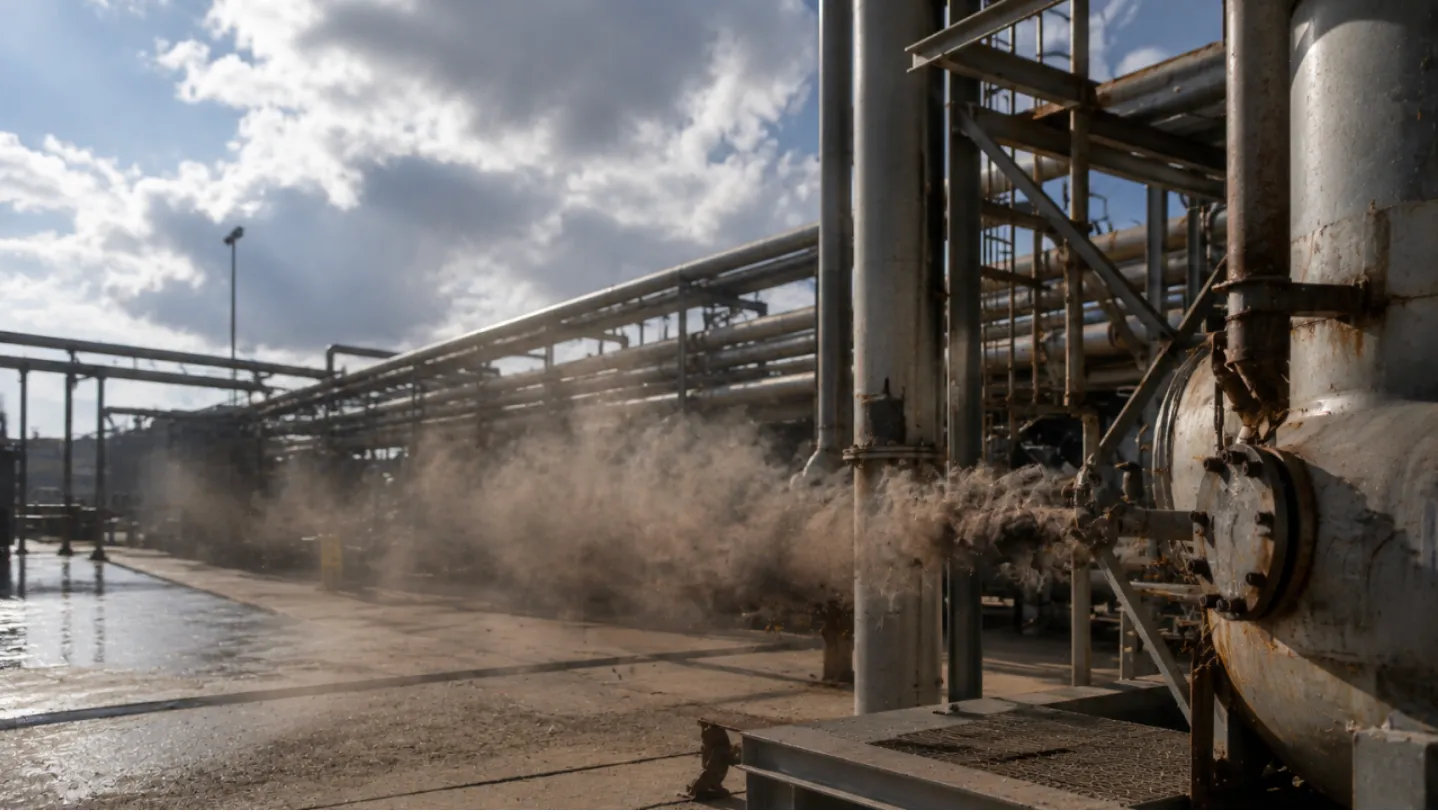
Outside does not automatically mean safe
In explosion safety assessments, a great deal of attention is often given to hazardous area classification, equipment certification and potential ignition sources. That is justified. Under the European ATEX framework, the employer must assess explosion risks and define appropriate technical and organisational measures. In the United Kingdom, the same principle is reflected in DSEAR: dangerous substances and explosive atmospheres must be assessed, controlled and managed throughout the work activity.
Yet in practice, a false sense of safety can arise as soon as an installation is located outdoors.
The reasoning seems understandable. Outdoors, natural ventilation can dilute released vapours, gases or dust more quickly than in an enclosed space. But the reality is less comfortable. Wind does not remove a release from the risk assessment. It transports it to wherever the surrounding conditions allow it to go.
During maintenance, shutdowns, inspections, cleaning activities or abnormal operating conditions, flammable substances may be released. Under the influence of wind, these releases can move towards areas where hot surfaces are present, where mechanical energy may be released, where electrical equipment is operating, or where temporary work is being carried out. Activities that appear low risk under normal operating conditions can become relevant when weather, process conditions and work activities coincide.
For designers, operators, maintenance teams and inspectors, explosion safety therefore does not start with the question of whether an installation is indoors or outdoors. The first question is whether, under realistic operating and foreseeable abnormal conditions, an explosive atmosphere can arise, how it can disperse and which potential ignition sources it may reach.
A plant may comply with the applicable requirements, use equipment selected in accordance with the ATEX Equipment Directive 2014/34/EU or the UK Equipment and Protective Systems Regulations, and be inspected in line with IEC/EN IEC 60079 practice. It may still be vulnerable to combinations of process deviations, weather influences and maintenance activities that are hardly visible during normal operation.
This is why scenario-based thinking deserves the same attention as formal hazardous area classification. IEC/EN IEC 60079-10-1 and IEC/EN IEC 60079-10-2 provide the technical framework for classifying gas, vapour and dust hazardous areas. But the quality of that classification depends on the assumptions behind it: source of release, ventilation, dispersion, operating conditions and foreseeable deviations.
Outdoors is not the same as risk-free. Natural ventilation may reduce the probability, extent or persistence of an explosive atmosphere, but only when its effect is realistically assessed. Sheltered corners, pipe racks, walls, vessels, equipment frames, building openings and temporary barriers can all influence dispersion. Wind direction, wind speed and local obstruction can determine whether a release is diluted, accumulated or transported towards a potential ignition source.
Under ATEX 1999/92/EC, and under DSEAR in the UK, the duty is not limited to normal production. Maintenance, inspection, cleaning, start-up, shutdown and foreseeable abnormal conditions must also be included in the explosion risk assessment. That is where many outdoor assumptions become weak. A situation may be safe during stable operation, but less robust when a flange is opened, a drain is released, a sample is taken, a hose is disconnected or temporary equipment is introduced.
Therefore, the key is not only to ask what normally happens, but also what could happen when conditions come together.
Where can a release occur?
How will wind and local geometry influence dispersion?
Can the release reach a hot surface, a mechanical ignition source or temporary electrical equipment?
Does the hazardous area classification still represent the real work situation during maintenance or abnormal operation?
The wind does not read a hazardous area drawing.
And that is precisely why outdoor installations require the same technical discipline as indoor installations: a realistic explosion risk assessment, clear assumptions, controlled ignition sources, verified equipment suitability, competent inspection and a management system that recognises when the real situation has moved beyond the original classification.
https://exquintia.com/
#ATEX #DSEAR #ExplosionSafety #ProcessSafety #IEC60079 #IECEx #HazardousAreas #RiskAssessment #IndustrialSafety #AssetIntegrity #Maintenance #Inspection #Engineering #ChemicalIndustry #FoodIndustry #SafetyCulture #Exquintia